
Annual Report 2025
On this page
SECTION 1: Land acknowledgement
The Canadian Human Rights Tribunal conducts hearings and mediations across Canada on traditional territories of Indigenous Peoples. We prepared this report in Ottawa, the traditional unceded and unsurrendered land of the Algonquin Anishinabeg People. We honour and pay respect to these lands and to all First Nations, Inuit and Métis Peoples.
We all have a role to play in the process of reconciliation. We invite you to learn more about the people whose traditional lands you are on.
SECTION 2: Who we are
The Canadian Human Rights Tribunal (the “Tribunal”) is an administrative tribunal. We work hard to be less formal than a court. We are independent and work at arm’s length from the federal government. This means that no minister or other government official can tell us how to decide our cases. We are accountable to Canadians and report on our activity to Parliament through the Minister of Justice.
Under the Canadian Human Rights Act (CHRA), the Tribunal hears cases of discrimination involving federally regulated organizations like the military, airlines, interprovincial trucking, banks and the federal public service. Tribunal members are decision-makers. They hear complaints of discrimination that have been referred to the Tribunal by the Canadian Human Rights Commission (the “Commission”). Tribunal members review submissions and evidence, listen to witnesses at hearings and decide whether discrimination has occurred. If the Tribunal member determines that discrimination occurred, they can rule on remedies. Parties can decide to settle their complaints through mediation or proceed to a hearing.
The Tribunal also has two other mandates. The first is under the Pay Equity Act (PEA), which requires employers to take a proactive approach to giving men and women equal pay for doing work of equal value. We have two roles under the PEA:
- the Pay Equity Commissioner can refer an important question of law or a question of jurisdiction to the Tribunal to determine; and
- an employer, bargaining agent (e.g., union) or other affected person may appeal some of the Pay Equity Commissioner’s decisions or orders to the Tribunal.
We are also preparing to make decisions under the Accessible Canada Act (ACA), which aims to ensure that everyone in Canada can fully participate in society by requiring federal organizations to proactively identify, remove and prevent barriers to accessibility for persons with disabilities. Our role under the ACA is to decide appeals of certain decisions made by the Accessibility Commissioner.
As of December 31, 2025, the Tribunal consists of the Chairperson, the Vice-Chairperson and eight full-time members. Seven part-time members work from various places across the country.
SECTION 3: Message from the Chairperson
On behalf of the Canadian Human Rights Tribunal, I am pleased to present our 2025 Annual Report. In 2025 we continued to use our enhanced adjudicative capacity to move files forward and reduce delay.
With a full complement of members for the first time in the history of the Tribunal, we have been able to hear and decide cases more promptly. We have no backlog of files waiting to be assigned.
The Tribunal has a clear statutory mandate to hear and decide cases fairly and efficiently. As I mentioned last year, endless, undisciplined litigation serves no one and undermines public confidence in the Tribunal. Litigation has its limits, and the Canadian Human Rights Act does not grant parties an unqualified right to spend an infinite amount of time on all issues they wish to explore in the context of their proceeding.
Litigation also comes with responsibilities. As the Tribunal has held, “...parties to proceedings are not simply innocent passengers being carried along the road to the end of their hearing, with no control over the outcome or the time and path taken to get there. They have responsibilities and must respect the process and comply with the Tribunal’s Rules and directions for their proceedings to advance” (Richards v. Correctional Service Canada, 2025 CHRT 107 at para 61).
The Human Rights Tribunal of Ontario has confirmed the responsibilities that parties bear when they choose to file a human rights complaint which engages public resources: “[t]he opportunity for an individual to make a claim of discrimination to a publicly funded adjudicative body, which has extensive procedural and remedial powers, comes with the obligation to respect the seriousness and significance of the process, and comply with the Tribunal’s Rules. The Tribunal’s procedures are less formal than a court’s and aim to enhance access, including for those parties who may be self-represented. But this informality should not be interpreted to mean that parties may take a casual attitude towards complying with Tribunal directions” (Ouwroulis v. New Locomotion, 2009 HRTO 335 at paras 4-7).
Parties who initiate human rights proceedings have an obligation to comply with the Rules, to participate actively in their proceedings, and to make reasonable requests. If they fail to respect Tribunal directions, seek to unreasonably expand their complaints, are generally unavailable for their hearings, or request multiple extensions and adjournments, this will invariably add complexity and delay to our proceedings. Further, litigation is not a contest of volumes. Adding more witnesses, arguments or documents to rely on also does not necessarily increase a party’s chances of success. In fact, the opposite is often true. Moreover, longer hearings lead to longer reserves, which lead to longer reasons, all of which have a profound impact on our ability to provide effective and timely adjudication to other parties waiting for their files to be heard.
While the parties play a key role, it is ultimately up to the Tribunal to control its own proceedings, and to set limits as needed. Members are independent, but we share a collective obligation to respect the statutory mandate Parliament chose to confer on the Tribunal.
We must therefore remember why we are here. Answering questions for Canadians who have chosen to access the federal human rights regime is not an academic exercise, nor is it one that is meant for the benefit of the Tribunal, adjudicators, or counsel. Behind each complaint are individuals or organizations who have chosen to make a claim of discrimination, or who are alleged to have engaged in a discriminatory practice. Win or lose, we need to decide the issues that divide them fairly and efficiently.
In my fourth year as Chairperson, I am pleased to highlight key achievements from 2025.
First, our members, with the support of mediators and staff, have
- Increased the use of mediation-adjudication by over 260%
- Settled close to 60% of complaints through mediation or mediation-adjudication, saving a minimum of 361 hearing days
- Held 34% more case management conference calls to resolve issues and advance files to a hearing
- Held 192 hearing days
- Issued 117 decisions and rulings
- Closed 112 complaints
I thank Tribunal members, staff and mediators for their dedication and professionalism.
Looking ahead, we remain focused on resolving complaints fairly and promptly, respecting the scheme of the CHRA, and providing accessible service to the parties who appear before us.
Jennifer Khurana
Chairperson
Canadian Human Rights Tribunal
SECTION 4: 2025 in numbers
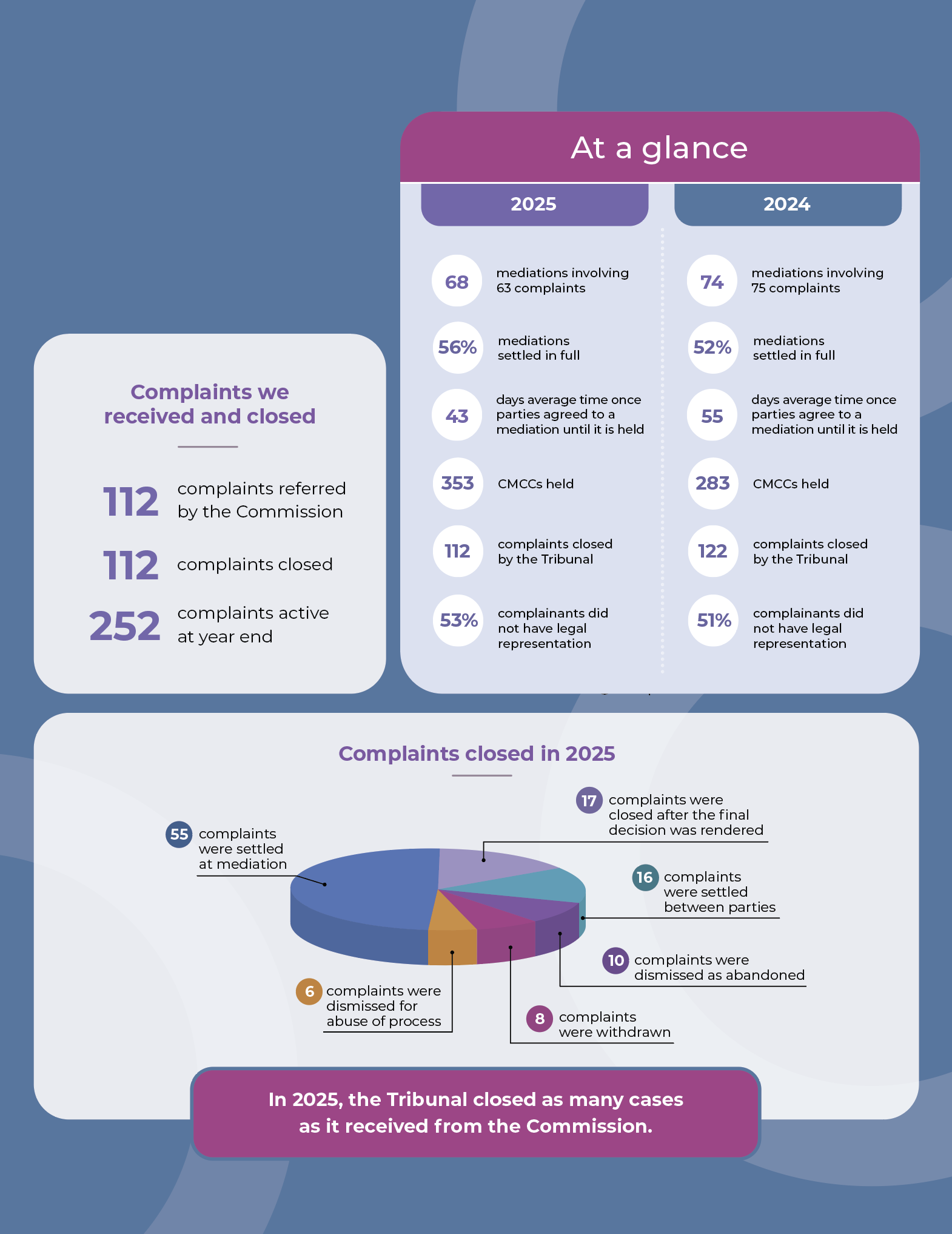
2025 in numbers
Complaints we received and closed:
- 12 complaints referred by the Commission
- 112 complaints closed
- 252 CHRA complaints active at year end
At a glance
2025:
- 68 mediations involving 63 complaints
- 56% of mediations settled in full
- 43 days - average time once parties agree to a mediation until it is held
- 353 CMCCs held
- 112 complaints closed by the Tribunal
- 53% of complainants did not have legal representation
2024:
- 74 mediations involving 75 complaints
- 52% of mediations settled in full
- 55 days - average time once parties agree to a mediation until it is held
- 283 CMCCs held
- 122 complaints closed by the Tribunal
- 51% of complainants did not have legal representation
Complaints closed in 2025
This pie chart titled “Complaints closed in 2025” shows a breakdown of complaints closed in 2025. The chart has six segments, labelled as follows (clockwise from the top):
- 55 complaints were settled at mediation
- 17 complaints were closed after the final decision was rendered
- 16 complaints were settled between parties
- 10 complaints were dismissed as abandoned
- 8 complaints were withdrawn
- 6 complaints were dismissed for abuse of process
In 2025, the Tribunal closed as many cases as it received from the Commission.
Referrals from the Canadian Human Rights Commission
In 2025, the Tribunal received 112 complaints from the Commission. This number has consistently increased over the past three years.
Judicial reviews
Four complaints were returned to the Tribunal after the Federal Court set aside two Tribunal decisions. Those Federal Court decisions were Canada (Canadian Human Rights Commission) v. Canada (Attorney General), 2025 FC 18 and SM v. Canada (Attorney General), 2025 FC 1893 (involving three complaints).
New complaints by categories of discrimination 2025
More than half of the 112 new complaints that the Commission referred to the Tribunal identified at least one ground of discrimination among race, national or ethnic origin, or colour. Complaints can identify multiple grounds of discrimination. Disability and sex were the next most frequently cited grounds of discrimination (both at 36%). Age (31%) and religion (22%) were cited more frequently in 2025 than in 2024.
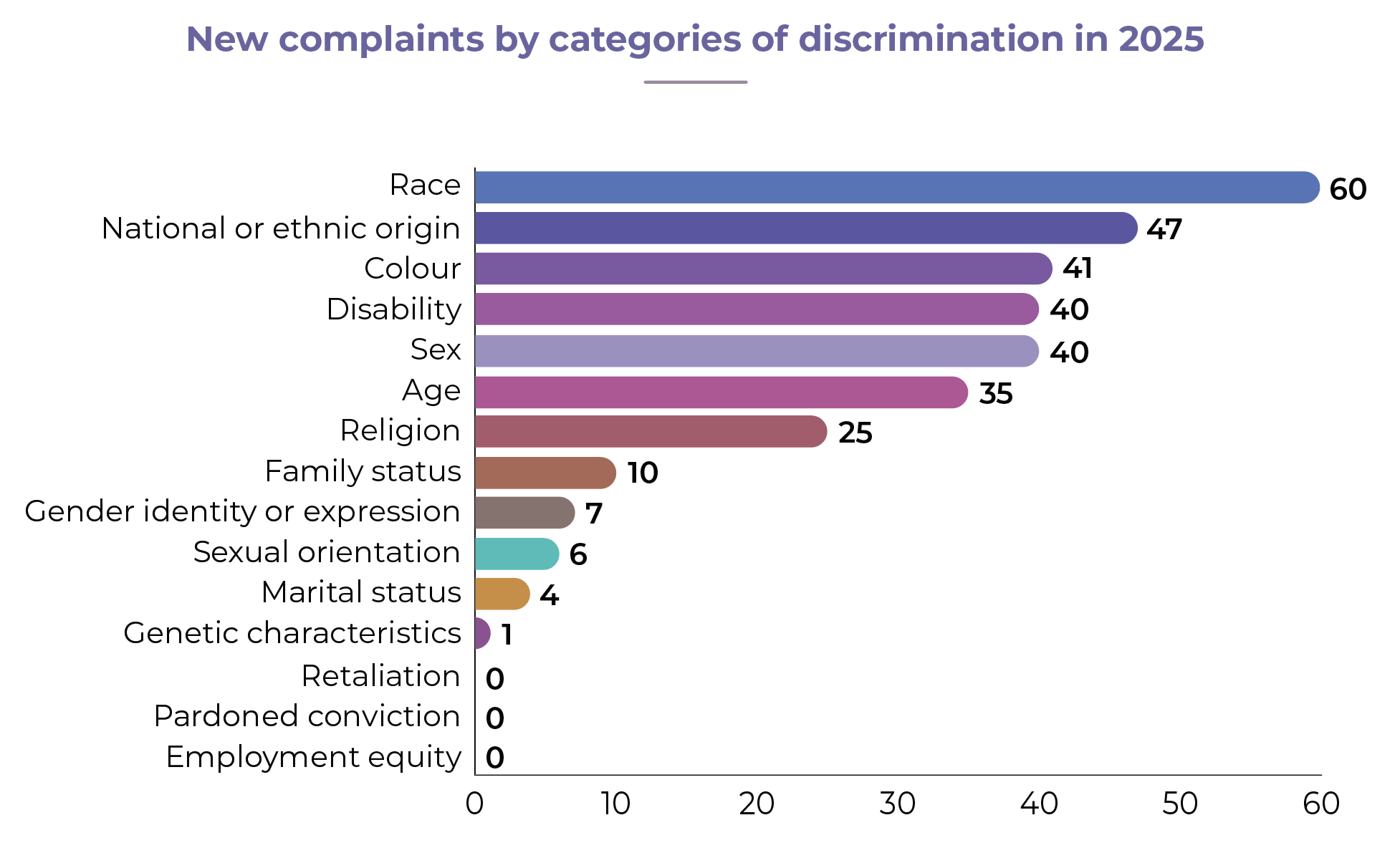
New complaints by categories of discrimination in 2025
This horizontal bar chart titled “New complaints by categories of discrimination in 2025” shows the number of new complaints received by the Tribunal in 2025.
There are 15 individual horizontal data bars showing the number of new complaints received in 2025. Each data bar corresponds to a prohibited ground of discrimination as set out in the Canadian Human Rights Act. The length of each horizontal bar is proportional to the number of new complaints that include that ground of discrimination. The scale of the horizontal axis goes from 0 to 50, in increments of ten.
New complaints by categories of discrimination in 2025:
- Race: 60
- National or ethnic origin: 47
- Color: 41
- Disability: 40
- Sex: 40
- Age: 35
- Religion: 25
- Family status: 10
- Gender identity or expression: 7
- Sexual orientation: 6
- Marital status: 4
- Genetic characteristics: 1
- Retaliation: 0
- Pardoned conviction: 0
- Employment Equity: 0
Representation
This year, more than half of complainants did not have lawyers. There were also 2 complaints with self-represented respondents.
This is similar to trends from previous years where the Tribunal has a significant number of self-represented complainants and very few self-represented respondents.
Tribunal members must ensure the process is accessible to all litigants, including self-represented ones.
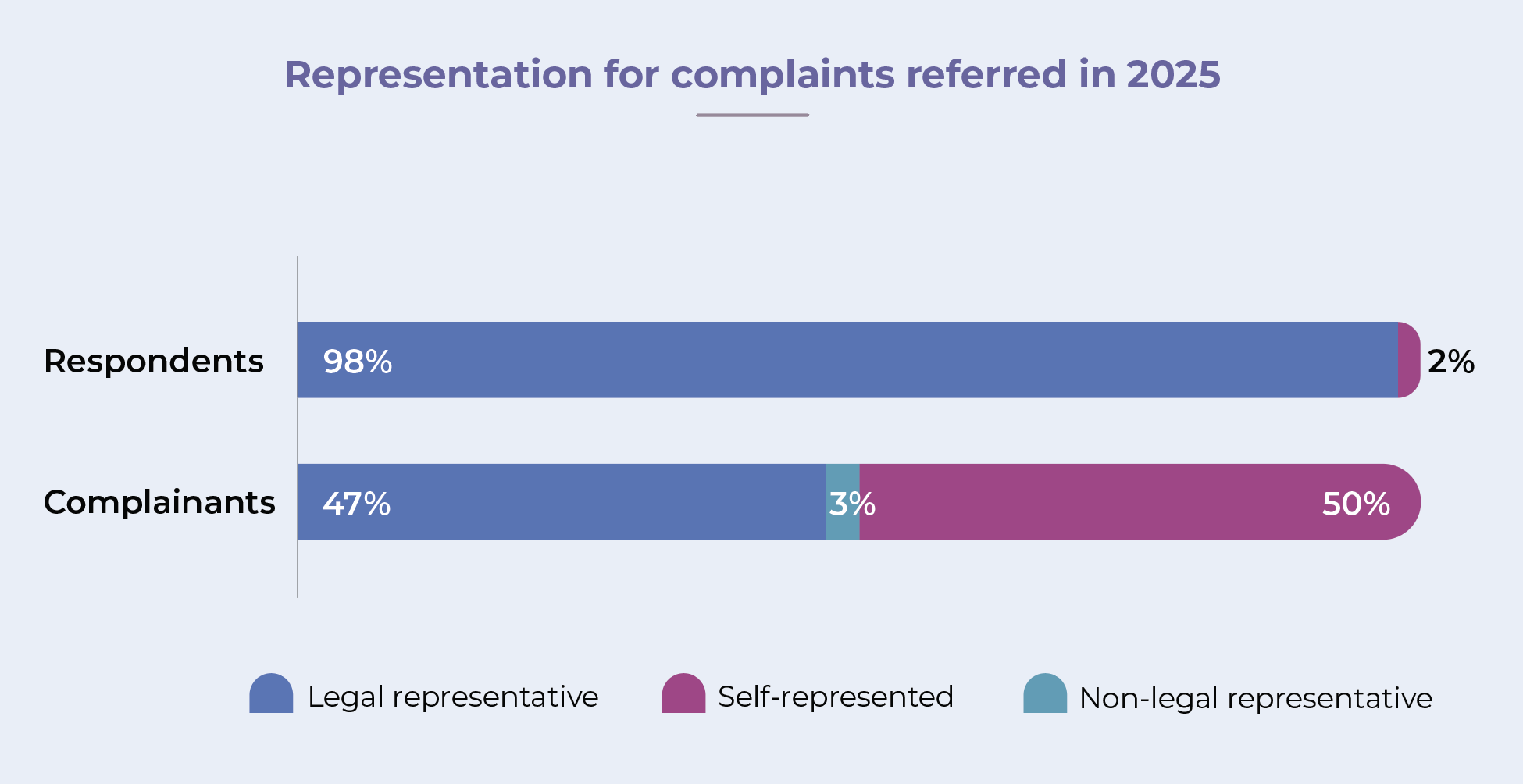
Representation for complaints referred in 2025
This horizontal bar chart titled "Representation for complaints referred in 2025" presents data on new complaints the Tribunal received in 2025 by type of party.
The chart contains two horizontal data bars: one for respondents and one for complainant. The axis scales are not numbered. Each horizontal bar shows the percentage for each type of representation: Legal representative, Self-represented party, or Non-legal representative.
Representation for complaints referred in 2025
From left to right, the bars show the following percentages:
1st bar – Respondents
- 98% Legal representative; 2% Self-represented
2nd bar – Complainants
- 47% Legal representative; 3% Non-legal representative; 50% Self-represented;
Commission participation
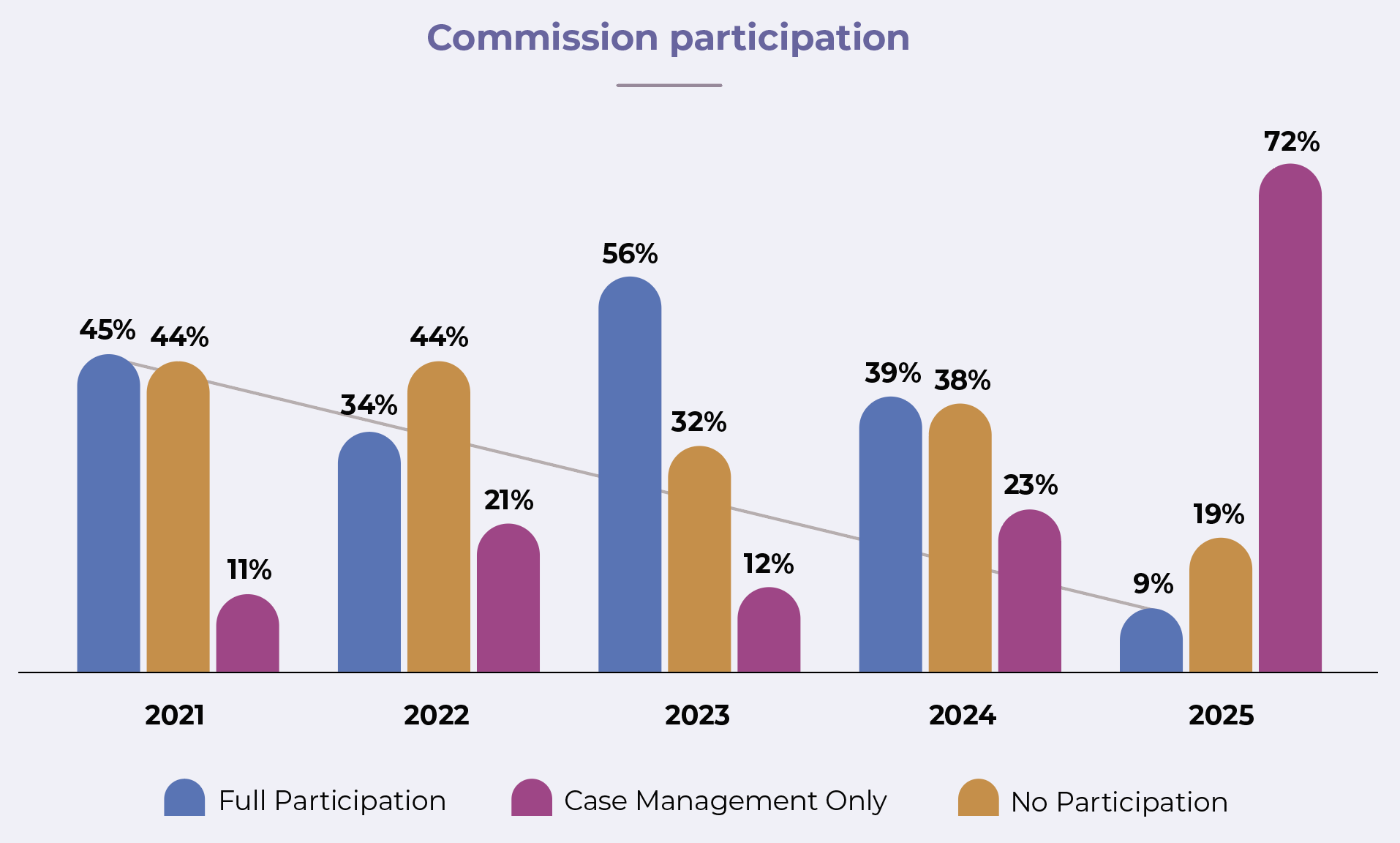
The Commission represents the public interest. When the Commission fully participates in a case, it attends case management conference calls and the hearing. When the Commission only partially participates, it observes case management calls but does not attend the hearing. In some cases, the Commission does not participate at all. This year, the Commission decided to fully participate in 9% of cases.
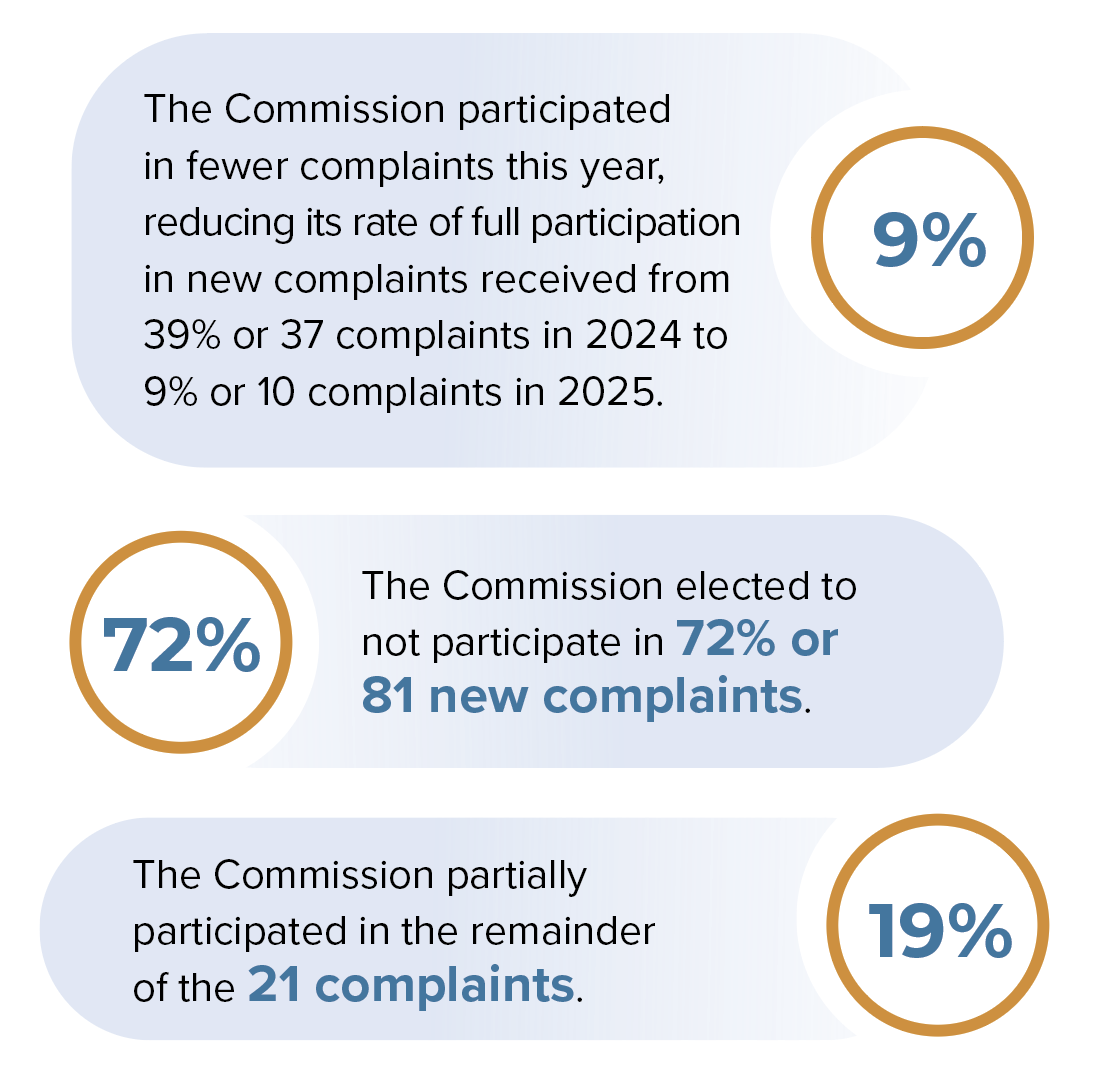
Commission participation
- The Commission participated in fewer complaints this year, reducing its rate of full participation in new complaints received from 39% or 37 complaints in 2024 to 9% or 10 complaints in 2025.
- The Commission elected to not participate in 72% or 81 new complaints.
- The Commission partially participated in the remainder of the 21 complaints.
Commission participation
A vertical bar chart entitled “Commission participation” presents the Commission’s participation, expressed as percentages, from 2021 to 2025.
The chart shows the evolution of the Commission’s participation over a five-year period, from 2021 to 2025. Three categories are compared: full participation, case management only, and no participation.
2021:
- 45% full participation, 11% case management only, and 44% no participation.
2022:
- 34% full participation, 21% case management only, and 44% no participation.
2023:
- 56% full participation, 12% case management only, and 32% no participation.
2024:
- 39% full participation, 23% case management only, and 38% no participation.
2025:
- 9% full participation, 72% case management only,
Types of respondents in 2025
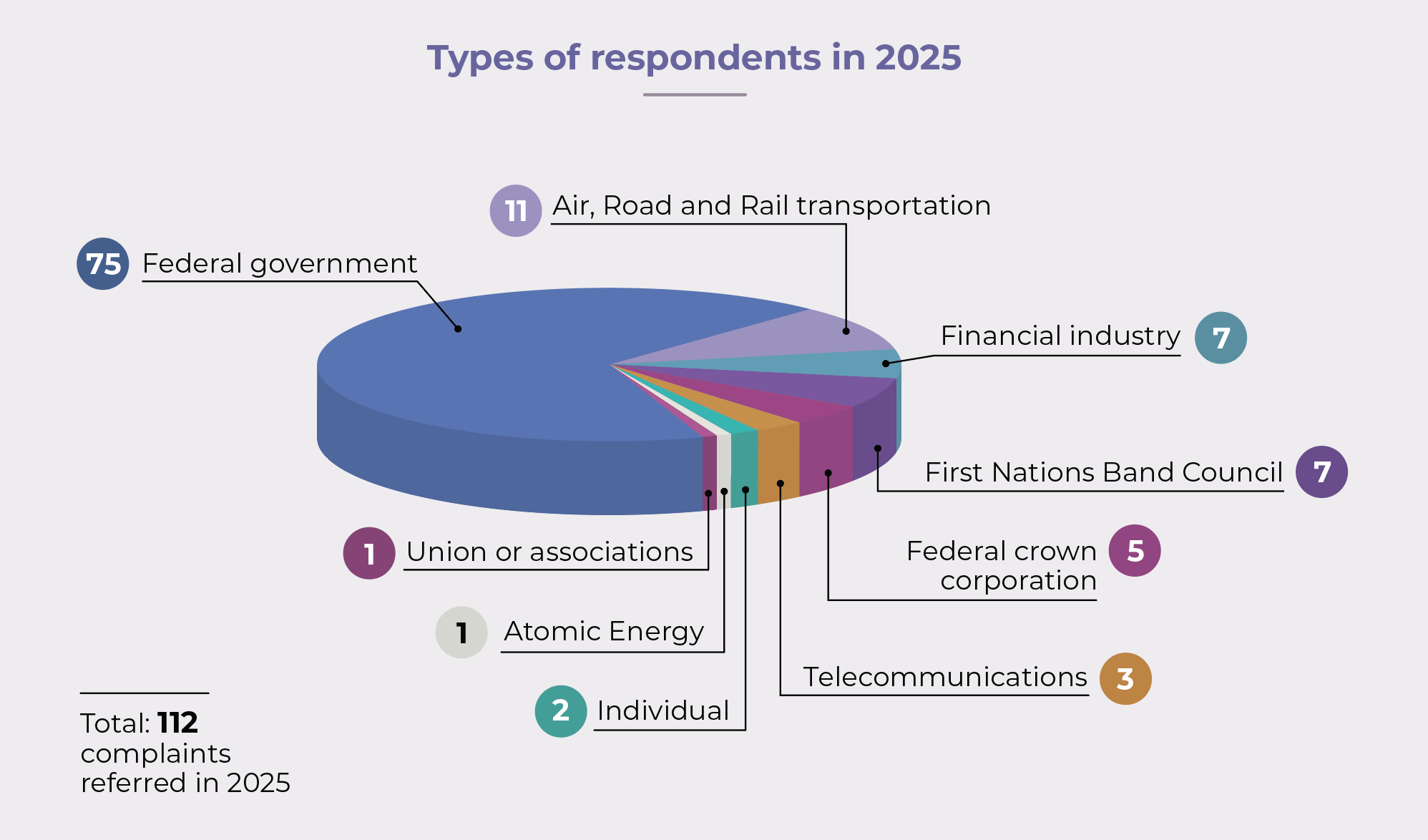
This pie chart is titled “Types of respondents in 2025”. It presents data on new complaints the Tribunal received in 2025 according to the type of respondent involved in each complaint.
There are 9 segments in this pie chart, one for each respondent type. Each respondent type segment has a number next to it for how many new complaints the Tribunal received in 2025 for that segment.
From the largest segment to the smallest in a clockwise order, the pie chart illustrates the following:
- Federal government: 55
- Air, road and rail transportation: 11
- Financial industry: 7
- First Nations Band Council: 7
- Federal crown corporation: 5
- Telecommunications: 3
- Individual: 2
- Atomic Energy: 1
- Unions or associations: 1
Total: 112 CHRA complaints referred in 2025
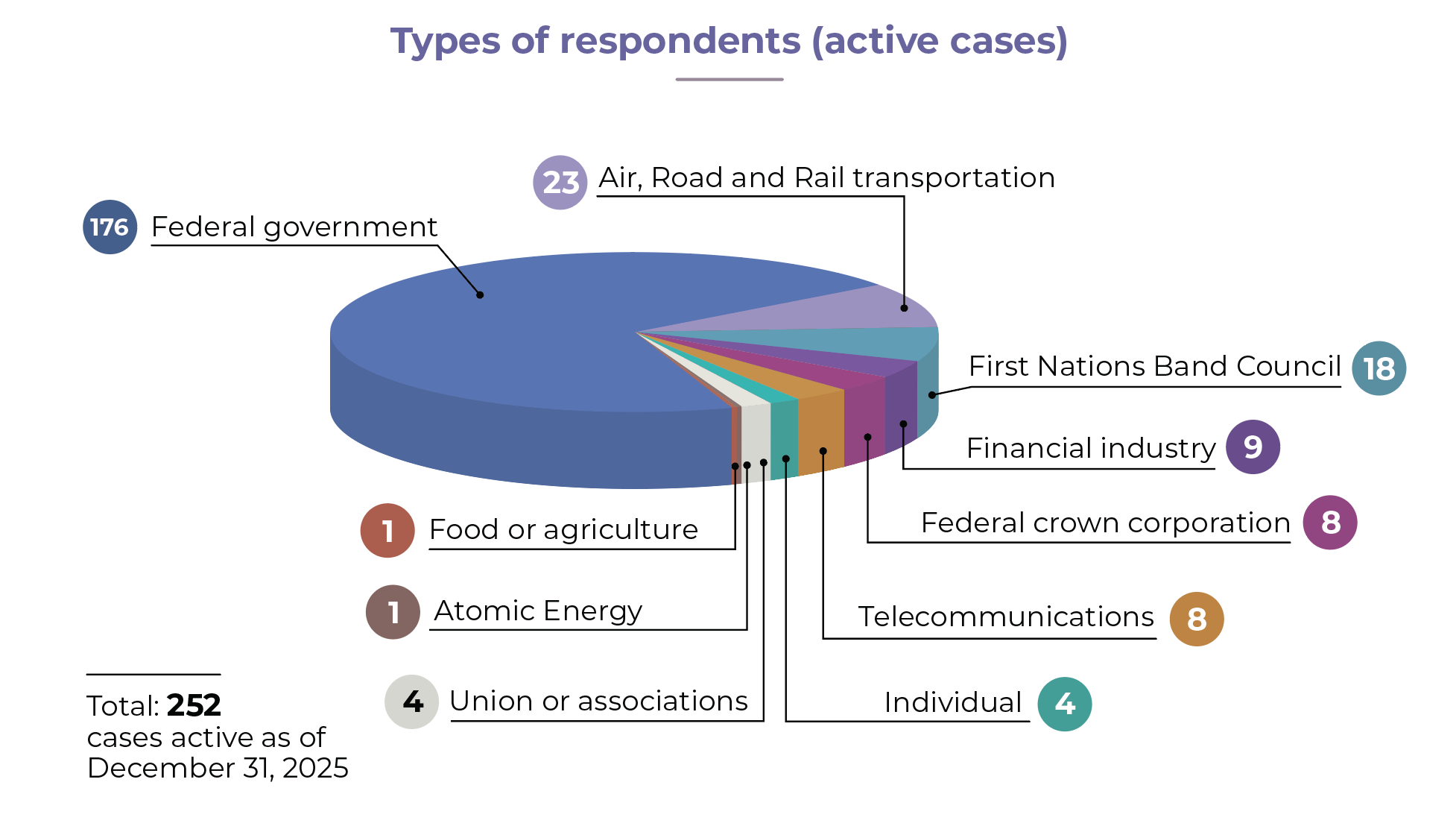
A larger percentage of active cases involve the federal government because these cases tend to be more complex and take longer to resolve.
Types of respondents (active cases)
This pie chart is titled “Types of respondents (active cases)”. It presents data on all active complaints with the Tribunal at the end of 2025, according to the type of respondent involved in each complaint.
There are 10 segments in this pie chart, one for each respondent type. Each respondent type segment has a number next to it for how many active complaints the Tribunal has for that segment.
From the largest segment to the smallest in a clockwise order, the pie chart illustrates the following:
- Federal government: 176
- Air, road and rail transportation: 23
- First Nations Band Council: 18
- Financial industry: 9
- Federal crown corporation: 8
- Telecommunication: 8
- Individual: 4
- Union or associations: 4
- Atomic Energy: 1
- Food or agriculture: 1
Total: 252 cases active as of December 31, 2025
Mediation results
In 2025, 68 mediations were held involving 63 complaints. While the Tribunal conducted 6 fewer mediations in 2025 than in 2024, this decrease is largely attributable to the large proportion of complaints that the Commission referred in the last three months of 2025.
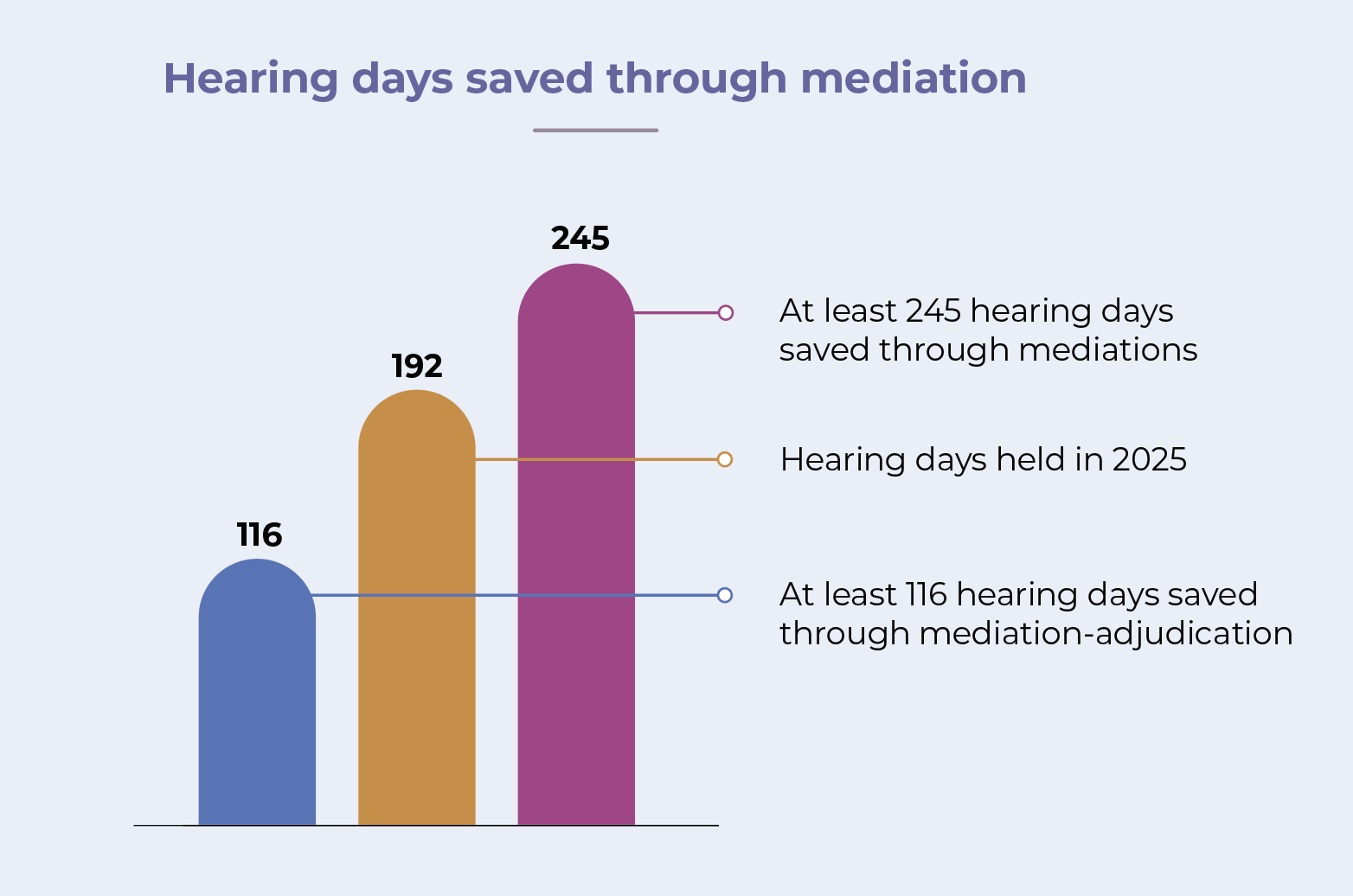
Some files settle later in the process, and this investment in alternative dispute resolution is paying dividends. Of the 63 complaints, 56% settled. These settlements resulted in a saving of at least 245 hearing days.
In 2025, Tribunal members participated in 29 mediation-adjudications where they acted as a mediator in cases they were assigned to adjudicate. Mediation-adjudication was successful in 17 of these complaints and the cases were completed without a hearing, saving the parties and the Tribunal at least 116 days of hearings.
Through 55 successful mediations or mediation-adjudications, the Tribunal’s roster of experienced human rights mediators and members saved the parties at least 361 hearing days.
Hearing days saved through mediation
A vertical bar chart entitled “Hearing days saved through mediation” presents data on the number of hearing days saved through mediation and mediation-adjudications. The chart also shows the number of hearing days held in 2025.
The chart contains three vertical bars: one for hearing days saved through mediation, one for hearing days held in 2025, and one for hearing days saved through mediation-adjudication. The bars are presented in ascending order—from the shortest to the tallest—and the number is indicated above each bar.
From left to right, the bars indicate the following:
- 116 – At least 116 hearing days saved through mediation-adjudication
- 192 – Hearing days held in 2025
- 245 – At least 245 hearing days saved through mediation
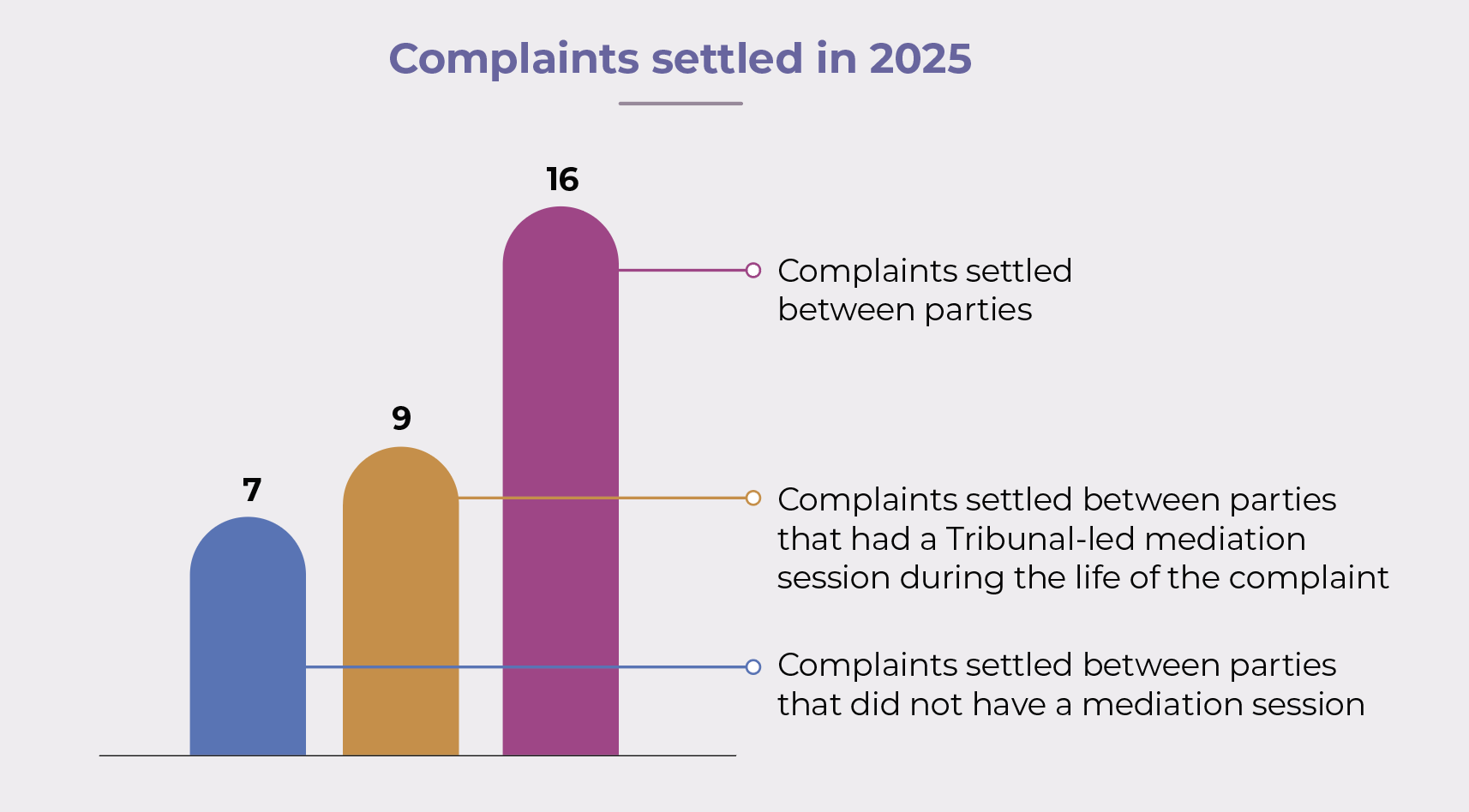
Complaints settled in 2025
This vertical bar chart shows the types of settlements for cases settled in 2025.
There are three segments in this vertical chart, one for each settlement type. There is no scale for the axes. The height of each of the three bars is proportional to the number of complaints settled by that settlement type and includes the total number for each.
Going from left to right, the chart illustrates the following:
- 7, the number of complaints settled between parties that did not have a mediation session
- 9, the number of complaints settled between parties that had a Tribunal-led mediation session during the life of the complaint
- 16, the number of complaints settled between the parties
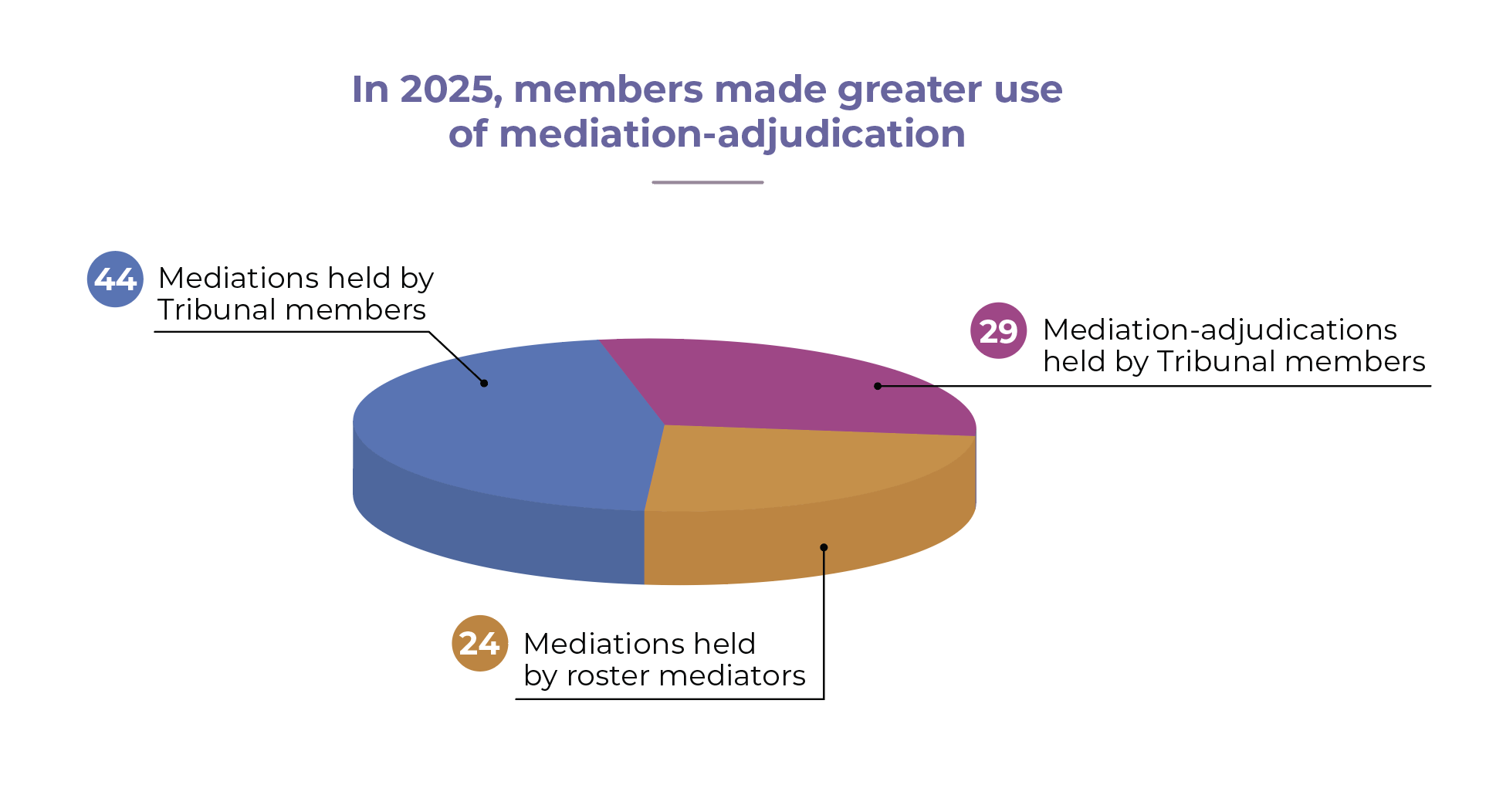
In 2025, members made greater use of mediation-adjudication
The pie chart titled “In 2025, members made greater use of mediation-adjudication” shows a breakdown of mediations and mediation-adjudications held by Tribunal members or roster mediators. The chart has three segments, labelled as follows (clockwise from the top):
- 44, mediations held by Tribunal members
- 29, mediations-adjudications held by Tribunal members
- 24, Mediations held by roster mediators
Hearings
In 2025, the Tribunal heard 41 cases for a total of 192 hearing days. The Tribunal conducted the majority of its hearing days through virtual hearings in 2025. The Tribunal offers the parties in-person and virtual hearings. A hybrid approach may also be appropriate in some cases.
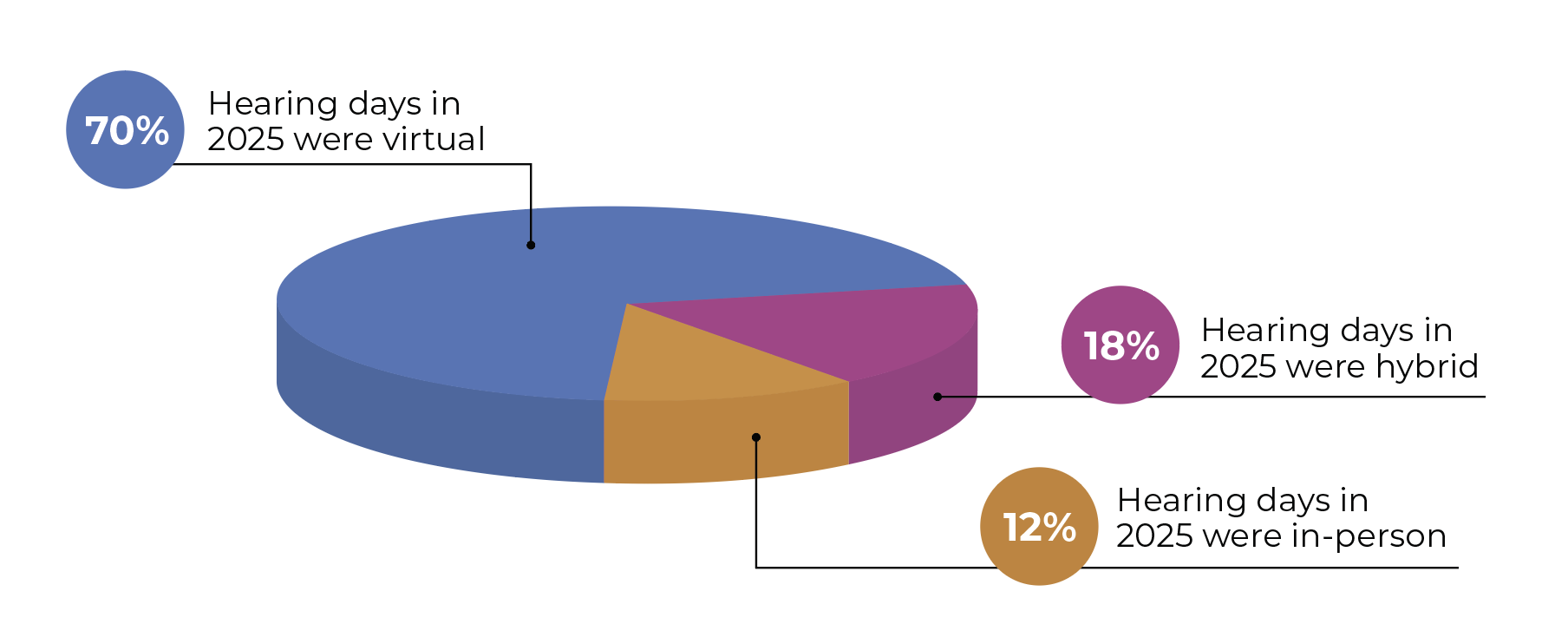
Hearings
An untitled pie chart presents the distribution of hearing formats, namely virtual, hybrid, and in-person hearings. The chart has three sectors, which indicate the following, clockwise starting from the top:
- 70%, hearing days in 2025 were virtual
- 18% hearing days in 2025 were hybrid
- 12% hearing days in 2025 were in-person
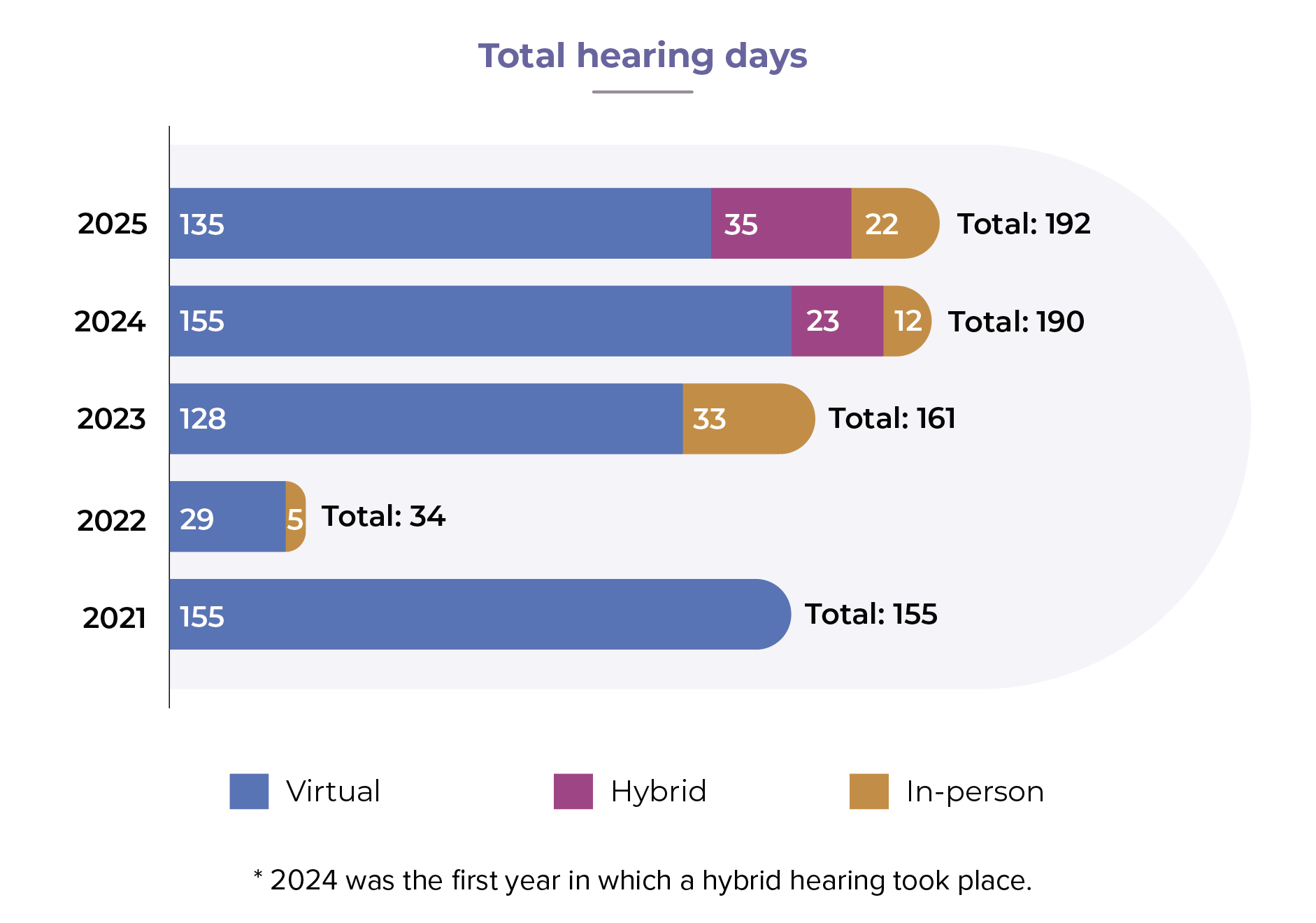
Total hearing days
A horizontal bar chart entitled “Total hearing days” presents the distribution of hearing formats, namely virtual, hybrid, and in-person hearings, from 2021 to 2025.
The chart contains five vertical bars, one for each year, starting with 2025. Each bar is divided into one to three sections representing each hearing format. The number of hearing days for each section is shown inside the section, and the total is displayed at the end of each column.
- 2025 – 135 virtual, 35 hybrid, 22 in person. Total: 192
- 2024 – 155 virtual, 23 hybrid, 12 in person. Total: 190
- 2023 – 128 virtual, 33 hybrid. Total: 161
- 2022 – 29 virtual, 5 in person. Total: 34
- 2021 – 155 in person. Total: 155
* 2024 was the first year in which a hybrid hearing took place.
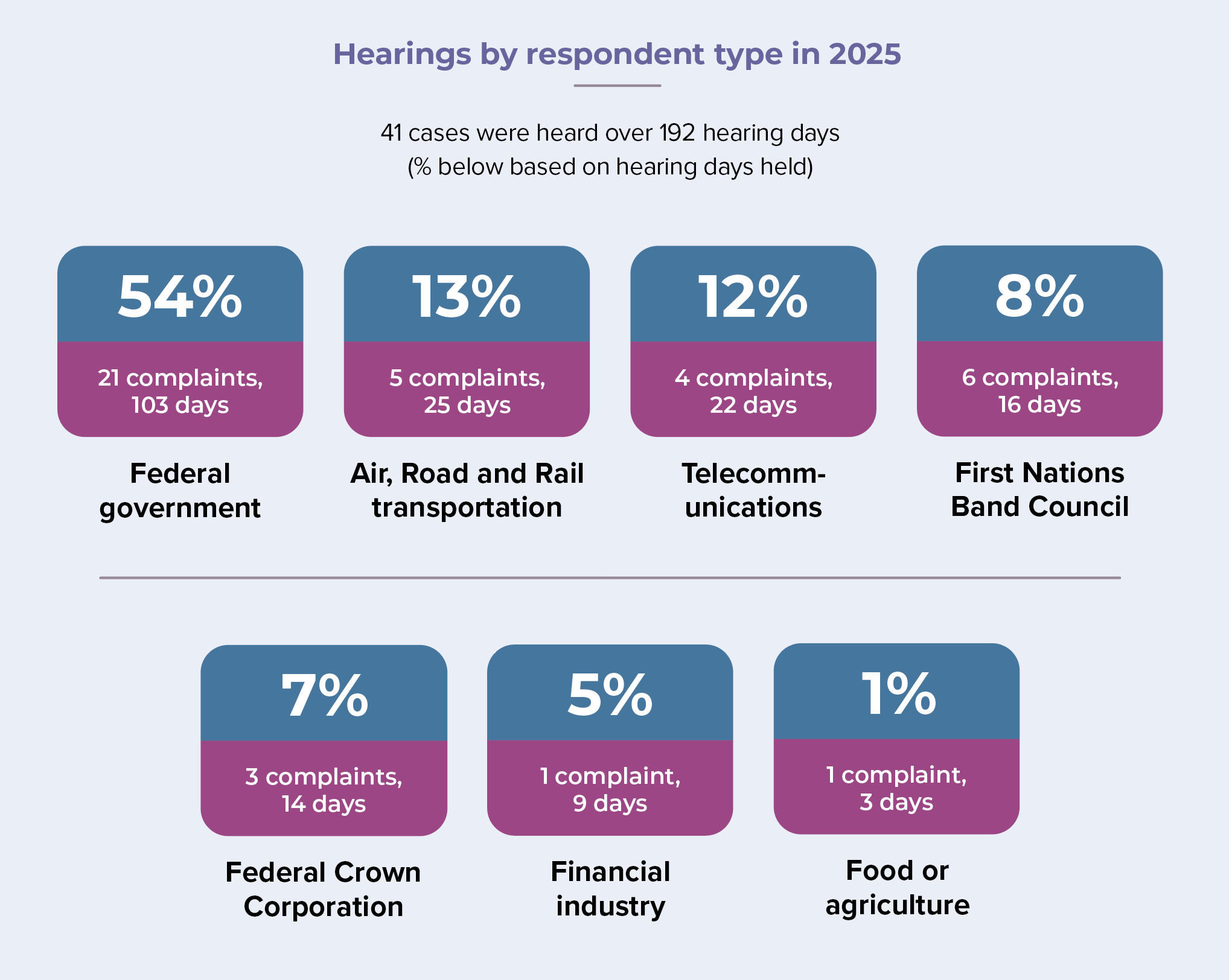
Hearings by respondent type in 2025
In a graphic titled “Hearings by respondent type in 2025”, there are 7 boxes in two rows for the different types of respondents that appeared at hearings before the Tribunal in 2025. Each box displays a percentage in the top half, while the bottom half contains the number of complaints and hearing days. The 7 boxes are as follow:
- Federal government: 54%, 21 complaints, 103 days
- Air, road and rail transportation: 13%, 5 complaints, 25 days
- Telecommunications: 12%, 4 complaint, 22 days
- First Nations Band Council: 8%, 6 complaints, 16 days
- Federal crown corporation: 7%, 3 complaints, 14 days
- Financial industry: 5%, 1 complaints, 9 days
- Food or agriculture: 1%, 1 complaint, 3 days
Rulings and decisions
In 2025, Tribunal members released 87 rulings. Rulings are any published reasons that do not decide the final outcome of the case. They usually address a procedural issue that parties need to resolve before a hearing. The Tribunal also issues directions to parties as they move through the steps of the process.
In contrast to a ruling, a decision is when a Tribunal member issues written reasons that decide the core issues in the case or ends the case. A decision usually sets out whether discrimination occurred and, if so, determines what remedy should be ordered because of the discrimination. The Tribunal issued 30 final decisions in 2025. Of those, 17 were issued after a hearing was held. The rest were decisions where the complainant did not appropriately pursue their case.
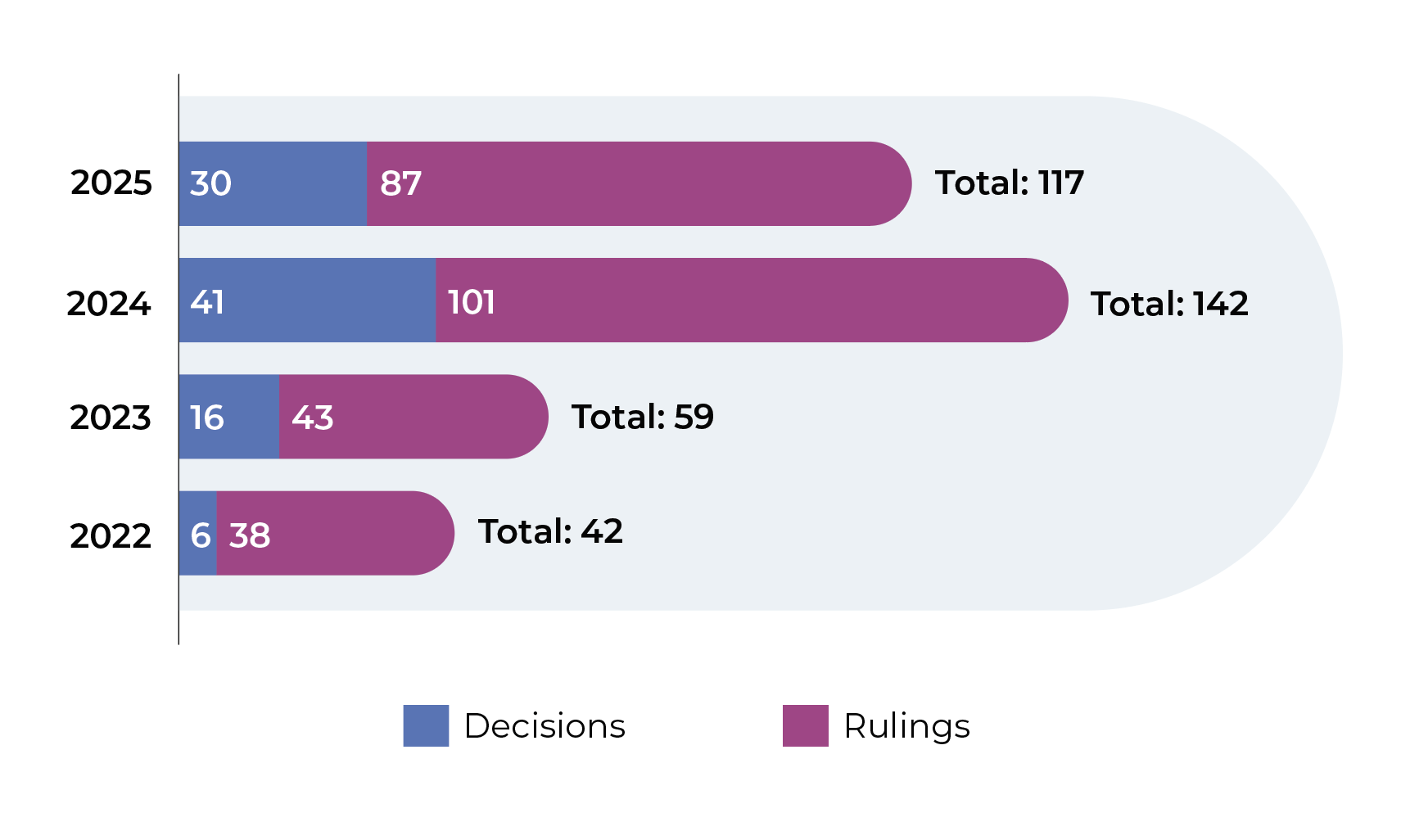
Rulings and decisions
The chart contains four horizontal bars, one for each year between 2022 and 2025. The bars extend from left to right. The axis scales are not numbered, but each bar represents the number of rulings and decisions rendered for each of these years. The number of decisions is shown at the end of each bar.
The chart shows the following:
- 2025: 30 decisions and 87 rulings. Total: 117
- 2024: 41 decisions and 101 rulings. Total: 142
- 2023: 16 decisions and 43 rulings. Total: 59
- 2022: 6 decisions and 38 rulings. Total: 42
SECTION 5: Mediation
Mediation is a voluntary and confidential option for parties who want to try to resolve their complaint before it goes to a hearing.
The parties control the process and can decide the outcome with certainty in the result.
Mediation is significantly faster and more cost-effective than a hearing. It saves time and resources for the parties, the Tribunal and the public. It is also an effective means for the Tribunal to reduce backlogs and avoid delays in the resolution of complaints.
Some complaints are highly complex and include allegations of systemic discrimination. Even if mediation does not initially settle the entire complaint and the matter needs to proceed to a hearing, it is never a waste of time or a failure. Mediation can help reduce the number of issues in dispute, which means that the parties can move through case management and to a hearing more quickly. Mediation can also lay the foundation for the parties to resolve the case between them. This year, over half of the complaints resolved between the parties had previously benefited from a Tribunal-assisted mediation.
The Tribunal has a roster of highly experienced human rights mediators who work with the parties to settle the complaint or part of the complaint. They help the parties consider options and provide valuable perspective and insight.
The Chairperson can appoint a mediator early in the process. Where the parties are ready to proceed expeditiously, the Tribunal can offer amediation within days. A Tribunal mediator can also work with the parties as the case moves forward in case management to try to facilitate settlement at any stage.
Where Tribunal members have acted as mediators, they have increasingly done so in the context of cases that they are already assigned to adjudicate through mediation-adjudication.
The Tribunal’s dedicated mediators and Tribunal members conducted 97 mediations and mediation-adjudications, which successfully settled 52 complaints. These successful settlements collectively saved a minimum of 361 hearing days in 2025. This represents a considerable savings for the parties and allowed the Tribunal to dedicate scarce resources to complaints that were proceeding to a hearing.
The Tribunal will continue offering mediation to its parties as an alternative to litigation.
“Even if mediation does not initially settle the entire complaint and the matter needs to proceed to a hearing, it is never a waste of time or a failure.”
SECTION 6: Case management
“What will undermine the Tribunal’s mandate is to refuse to set limits where they are warranted and to abdicate Tribunal management of an inquiry that must proceed fairly and expeditiously”
(Richards v Correctional Service Canada, 2025 CHRT 57 at para 45)
The Tribunal must carefully manage its limited resources so that it can execute its statutory mandate and serve all parties.
Many of the complaints that the Commission refers to the Tribunal engage novel issues of law and allegations of multiple and intersecting grounds of discrimination. Complaints alleging systemic discrimination in the delivery of a government service often involve voluminous disclosure and lengthy witness lists, including experts. These files are complex and require active and ongoing case management to move them forward efficiently.
However, case management also requires the Tribunal to ensure that simpler, more discrete complaints do not grow into overly complex and lengthy proceedings that engage a disproportionate amount of the parties’ and the Tribunal’s time.
The Tribunal remains committed to delivering on the promise of administrative justice and to simplifying its processes to get there. To achieve this goal, we did the following:
- We continued to use early case management calls, held by the Chairperson, in all files involving self-represented litigants to explain the Tribunal process in plain language, explore the possibility of mediation, and answer the parties’ questions. Another goal of these proactive calls is to minimize motions and other causes of delay and to ensure everyone understands their rights and obligations in the Tribunal process. In 2025, the Chairperson held 47 of these calls.
- We offered mediation-adjudication in all files and at all stages of the process. Through this approach, the member hearing the case takes on a mediation role to assist parties in resolving the complaints or reducing the issues in dispute.
- We continued training members on hearing management. When parties wish to bring a motion, Tribunal members are encouraged to use the most appropriate tool to resolve the dispute between the parties. Often, this can be a case management call or brief oral directions rather than a formal motion. Detailed reasons are rarely needed in case management matters and the parties benefit more from prompt directions. This allows the parties to keep focused on getting to a hearing.
- This year’s professional development for members included a session on best practices for adjudicating in a fast-paced, high-volume environment. Tribunal members also participated in a session on how to case manage complex files involving allegations of systemic discrimination.
SECTION 7: The role of Tribunal members
Administrative tribunals like ours were created to deliver fair, timely, accessible, and specialized decision-making. The Tribunal consists of independent members who adjudicate complaints, make findings of fact on the evidence they hear, and issue reasons for decision. Being independent, however, does not mean that members are unaccountable for their work. It means, among other things, that members have a responsibility to respect the scheme of the CHRA and to stay true to Parliament’s intention in creating the Tribunal.
In practice this means that Tribunal members are expected to hear and adjudicate their complaints in a proportionate way with the context of our administrative tribunal in mind. The Tribunal was not created as a commission of inquiry, or to conduct inchoate, decades-long proceedings that continue to morph and expand over time, at the behest of the parties.
The Tribunal is mandated to inquire into complaints that have been referred to it; it is not our role to take a discrete question that Parliament mandated us to answer and turn it into an unfocussed hearing with an evergrowing list of witnesses and issues.
Our job is to provide “rough justice” in an accessible way, and not to make simple things hard or more complex. As adjudicators, if we fail to respect this statutory responsibility, we are not only straying from the intent and purpose of the CHRA; we are doing a disservice to our parties. This also undermines public confidence in our systems of justice. Tribunal members, and the public servants who support the Tribunal’s operations, are here to provide a service to Canadians.
Providing a fair process does not mean members should allow anything and everything, or that the parties’ right to a hearing is unlimited.
It means respecting the mandate the legislature conferred on the Tribunal and ensuring scarce Tribunal resources do not get engulfed by a handful of files, to the detriment of other Canadians who are waiting for their cases to be heard. This can mean setting limits where needed to meet our obligations under s. 48.9(1) of the CHRA to conduct proceedings as informally and expeditiously as the requirements of natural justice and the rules of procedure allow.
Further, by the time the Commission refers a complaint to the Tribunal, it is on average over 2.5 years old. Once it is referred, Tribunal members have a duty to move a case forward fairly and efficiently and to mitigate the challenges inherent in trying to hear evidence about alleged events that date back several years and are growing staler by the day.
This commitment to advancing files more expeditiously is starting to yield results. The average age of a complaint at the Tribunal decreased by just over four months, from two and a half years at the end of 2024 to two years and two months at the end of 2025. Furthermore, the Tribunal issued the final decision on the merits in Molyneaux v. National Arts Centre Corporation, 2025 CHRT 84 less than a year after it received the complaint. Similarly, the Tribunal was able to complete two hearings, each in a single day, while a further two hearings were completed in three days.
SECTION 8: Summaries of some 2025 decisions
Cases and decisions
The following cases are examples of the variety and complexity of issues our Tribunal members decide. The Tribunal’s decisions are published on our website.
Sidhu & Kopeck v. International Longshore and Warehouse Union Local 500, 2025 CHRT 11
Robert Kopeck and Kewal Sidhu, the Complainants, filed discrimination complaints against the International Longshore and Warehouse Union Local 500 (the “Union”), the Respondent. The Tribunal found that the Union’s policies discriminated against workers based on age, violating sections 9 and 10 of the CHRA.
The case centers on two Union policies: the Pensioner Dispatch Rule and the Pension Equalization Rule. Together, these policies result in workers who receive pension income only being given work assignments after all other Union members and casual workers, regardless of seniority. This particularly affects workers over the age of 71, who are legally required to collect pension income under Canadian tax law.
The Union put these rules in place in response to members’ concerns about “double dipping,” where older workers could earn both full wages and pension income. The Union argued that this practice was unfair to younger workers whose career development might be delayed.
The Tribunal found that the Complainants made out their case for discrimination. This was mainly because the policies took away job opportunities from older workers collecting a pension, and the Union’s own witnesses confirmed that the rules were designed to reduce work opportunities for pension-collecting workers in favour of younger workers. The decision reinforces that policies limiting work opportunities based on pension status can be considered age discrimination under the CHRA when pension collection is largely tied to age.
While the Union attempted to justify the policies, the Tribunal found their defense inadequate—the evidence did not show undue hardship.
This ruling addresses the liability phase of the case only. A separate hearing will determine appropriate remedies for the affected workers.
A judicial review of this decision has been filed in Federal Court (Federal Court File # T-833-25).
Kim v. Correctional Service Canada, 2025 CHRT 39
Frank Kim, the Complainant, is an inmate. He had previously filed two human rights complaints against the Correctional Service of Canada (CSC). The CHRA prohibits retaliation against individuals who file these complaints.
The Tribunal dismissed Mr. Kim’s allegation that the CSC retaliated against him because he had previously filed human rights complaints.
Mr. Kim alleged that he suffered retaliation based on a risk assessment a psychologist prepared for his parole hearing. The psychologist’s report noted that Mr. Kim filed many complaints and grievances. The psychologist viewed these complaints and grievances as a means for Mr. Kim to avoid taking responsibility. Mr. Kim attributed the Parole Board’s decision to deny him parole to the negative psychological report.
The Tribunal did not accept that a reference in the psychologist’s report to “complaints and grievances” included references to Mr. Kim’s two earlier human rights complaints.
The Tribunal found that the psychologist did not know about the two human rights complaints. There is no evidence the psychologist was aware of the human rights complaints because of the overwhelming number of other grievances and complaints. The human rights complaints were also kept in a separate part of Mr. Kim’s file to which the psychologist did not have access. There were only three brief and indirect references to the human rights complaints among the voluminous material to which the psychologist had access.
A judicial review of this decision has been filed in Federal Court (Federal Court File # T-1964-25).
Molyneaux v. National Arts Centre Corporation, 2025 CHRT 84
Kenneth Molyneaux, the Complainant, a professional chef who worked at the National Arts Centre (the NAC) from 2018 to 2024, alleged that the NAC discriminated against him based on his disabilities—chronic pain, depression, and post-traumatic stress disorder (PTSD)—by failing to provide reasonable workplace accommodations. He claimed that this forced him to retire early. The Tribunal dismissed Mr. Molyneaux’s complaint against the NAC.
The Tribunal explained that Mr. Molyneaux’s disabilities did not automatically trigger a duty on the part of the NAC to accommodate him. He first had to prove that he faced adverse differentiation and that there was a connection between these events and his disability.
The Tribunal found that only two of his requests for accommodation could have had an adverse impact on him by exacerbating his disabilities. However, it concluded that the NAC provided reasonable solutions and thereby met its duty to accommodate. Accommodations need not be perfect, only reasonable. The duty to accommodate also does not require employers to provide employees with their preferred accommodations.
The Tribunal concluded that Mr. Molyneaux’s allegations of adverse treatment based on disability were either unsubstantiated or justified as bona fide occupational requirements, and that Mr. Molyneaux failed to establish that he was forced to retire due to any prima facie discriminatory conduct or failure to accommodate by the NAC.
Dorais v. Canadian Armed Forces, 2025 CHRT 96
Joshua Dorais, the Complainant, alleged that the Canadian Armed Forces (the CAF) discriminated against him based on a previous medical diagnosis and a perceived ongoing disability when he applied to re-enroll in the CAF to work as a nurse. Mr. Dorais also claimed that the CAF systematically denied enrolment to all applicants who had a history of post-traumatic stress disorder (PTSD) or service-related PTSD. The CAF denied the allegations, stating that it had refused Mr. Dorais’ application after a proper assessment under its medical standard, and that its decision was justified. The CAF also claimed that it does not systematically reject applicants without appropriately considering their applications.
The Tribunal found that CAF discriminated against Mr. Dorais. However, it also found that the medical standard itself was not discriminatory.
The Tribunal found that CAF discriminated against Mr. Dorais because it did not conduct a prudent and fair assessment of his medical conditions. The CAF had a duty to accommodate Mr. Dorais, but its evaluation process failed to provide accommodation for Mr. Dorais’ disability up to the point of undue hardship. During the medical evaluation of Mr. Dorais’ application, it would not have been an undue hardship for the CAF to inform Mr. Dorais about the specific medical information that it needed to decide whether his medical conditions had been successfully treated and whether he had employment limitations related to PTSD. Therefore, the CAF did not justify its assessment of Mr. Dorais and decision to refuse his application. The Tribunal ordered the CAF to pay Mr. Dorais $9,000 for pain and suffering and $4,000 in special compensation.
The Tribunal largely dismissed Mr. Dorais’ claim that CAF’s medical standard was discriminatory. It found that the CAF justified its reliance on the medical standard that all applicants to the CAF must meet. As a policy, it is a bona fide occupational requirement that reflects the universality of service principle (that all CAF applicants must be capable of performing the core requirements of a soldier). However, some of the guidelines that CAF uses to assess applicants did not adequately consider PTSD. As such, CAF was ordered to update these guidelines if it had not already done so.
Rulings
The Tribunal regularly issues rulings to address procedural issues that parties need to resolve before a hearing. This year, many of the Tribunal’s rulings focused on its obligation to ensure that complaints proceed expeditiously and proportionately while ensuring a fair and predictable process for all parties. These rulings allow the Tribunal to more effectively manage even the most challenging and complex cases.
McCargar v. Correctional Service Canada, 2025 CHRT 15
Brook McCargar, the Complainant, filed two human rights complaints against the CSC. During the Tribunal’s process, Mr. McCargar repeatedly failed to follow the required steps. Even after the Tribunal gave him chances to fix his mistakes, he submitted extremely long and irrelevant lists of witnesses and remedies. CSC asked the Tribunal to dismiss the complaints for abuse of process and because it said Mr. McCargar caused unreasonable delays.
The Tribunal allowed the request and found that Mr. McCargar’s behaviour was abusive. It dismissed the complaints to protect the fairness of the process.
Richards v. Correctional Service Canada, 2025 CHRT 57
Mr. Richards, the Complainant, alleged that CSC discriminated against him in how it treated him as an inmate based on his race, colour, religion, disability, and sex. He wanted the two proposed witnesses to testify about events that did not involve him. Mr. Richards believed their experience showed a similar pattern of discrimination and would help his case.
The Tribunal must ensure the proceeding remains centered on Mr. Richards’ experience and allegations. Incidents involving other inmates interacting with different people at different times, in separate institutions, are not sufficiently similar to the facts and conduct at issue.
The Tribunal did not accept that the witnesses should be allowed as a result of Mr. Richards’ claims related to systemic discrimination. The evidence from these witnesses is not necessary to prove systemic discrimination and Mr. Richards did not identify the specific events they would address.
The Tribunal accepted that CSC would face prejudice if the two witnesses were allowed. The hearing must occur within a reasonable time period. Further, CSC should not be required to defend itself against a moving target.
Even in cases alleging systemic discrimination, the Tribunal must set limits so the case can proceed fairly and expeditiously. For the Tribunal to hear these cases, parties must be organised. The Tribunal cannot be paralyzed by an exhaustive foray into all potentially
relevant evidence. A Tribunal complaint is not a broad-ranging Royal Commission.
Ultimately, the purpose of a hearing is not to hear all relevant evidence at any cost. The parties do not have a right to infinite hearing time, even when there are allegations of systemic discrimination.
The Tribunal found that it is not sufficient to identify a general link between the complaint and the proposed evidence. The Tribunal must also ensure that hearings do not become entirely unworkable. These witnesses were only added to the witness list at a late stage in the proceedings, which undermined the claim that their evidence was of central importance. Their testimony would also lengthen the hearing significantly.
The Tribunal did not permit Ryan Richards to call the two other inmates as witnesses in his case.
Sargeant v. Correctional Service Canada, 2025 CHRT 77
Mr. Sargeant, the Complainant, a Black man, alleged that CSC discriminated against him based on his race, colour, national or ethnic origin, and sex. The events in this case happened while Mr. Sargeant was an inmate at Matsqui Institution.
The Commission filed a Statement of Particulars (SOP) supporting Mr. Sargeant’s claims. It also asked for remedies, saying that the case highlights systemic discrimination within the correctional system.
CSC alleged that parts of the Commission’s SOP exceeded the scope of Mr. Sargeant’s complaints and asked the Tribunal to strike some of the allegations and remedies. It also alleged that some of the requested remedies do not flow from the allegations made in this case. In the alternative, CSC asked for more details on any allegations in the SOP that the Tribunal may not remove, including two specific allegations raised in the SOP. Finally, CSC argued that parliamentary privilege prevents the Commission and Mr. Sargeant from using reports from a standing Senate committee.
The Tribunal granted CSC’s motion in part. It decided that the case should focus only on Mr. Sargeant’s specific allegations. It also explained that it cannot expand the case into a broad inquiry into systemic racism within the correctional system. It allowed background information about anti-Black racism for context but said that the Commission and Mr. Sargeant could not use this information to add new allegations to Mr. Sargeant’s original complaints.
As a result, the Tribunal struck portions of the SOP that went beyond the scope of those complaints. It also struck some requested remedies that did not flow from the allegations in those complaints such as remedies related to gang labelling, involuntary transfers unrelated to security classifications, and use of segregation. It also directed Mr. Sargeant to provide more information about two points in his SOPs that are unclear.
Finally, the Tribunal agreed that parliamentary privilege protects reports of the Standing Senate Committee on Human Rights, meaning that the Commission and Mr. Sargeant cannot use them as evidence in this case.
Liu (on behalf of IPCO) v. Public Safety Canada, 2025 CHRT 90
Kai Liu, the Complainant, filed a complaint on behalf of Indigenous Police Chiefs of Ontario (IPCO). IPCO says that Public Safety Canada (PSC) discriminates in how it runs the First Nations and Inuit Policing Program (FNIPP). This ruling deals with five preliminary requests brought by the parties.
First, the Tribunal decided that the complaint should only cover events from 2014 to November 7, 2024. This decision aims to balance IPCO’s right to present a full case against the principles of proportionality and efficiency in using Tribunal resources. IPCO can still present evidence on events before 2014, like the creation of the FNIPP, for background or context. The Tribunal told IPCO to strike unclear parts from its SOP to make it more focused and easier to follow. It also decided that it was too early to dismiss IPCO’s allegations about how discriminatory underfunding harmed policing for its members.
Second, the Tribunal denied IPCO’s request to bring more than five expert witnesses under section 7 of the Canada Evidence Act. IPCO’s request for two more experts, if the Tribunal had accepted it, would have repeated information rather than offering new insights. The Tribunal explained that, even in complex public-interest cases, it is necessary to strike a balance between thoroughness on the one hand, and proportionality and efficiency on the other.
Third, the Tribunal told IPCO to submit more details and documents about its allegations. It said that parties must specify the “who, when, where, how, and what” to explain the alleged harm. These rules apply both to cases of systemic discrimination and to individual complaints, but IPCO does not need to create new documents or share information that PSC already has.
Fourth, the Tribunal found that the doctrines of issue estoppel and abuse of process do not apply here. Other cases have dealt with similar FNIPP issues. But those cases involved questions, parties, and contexts (such as provinces or communities) that were too different for estoppel to apply. Findings from those cases could still influence this one.
Firth, the Tribunal rejected IPCO’s request to split the hearing into two parts—one to decide liability and another to decide on remedies. It said that the issues are too connected, and splitting the hearing would waste time and make the process less efficient. The Tribunal decided to hear all issues together, as it expects that many witnesses will address both liability and remedies.
In this ruling, the Tribunal stressed the importance of being thorough as well as proportionate and efficient when dealing with complex systemic discrimination cases. It also noted that, to fulfill its mandate, all parties need to approach their cases in a balanced and proportionate way.
Richards v. Correctional Service Canada, 2025 CHRT 93
Mr. Richards, the Complainant, is an inmate. He filed four complaints against CSC, alleging that it discriminated against him in providing a service. This ruling adresses two more complaints where Mr. Richards says that CSC retaliated against him because of his four earlier human rights complaints.
A complainant is allowed to amend a complaint to more clearly focus on the real questions in dispute in the case. However, a complaint cannot be amended such that it essentially introduces a new and unrelated complaint. The Tribunal has an obligation to respect the terms of the CHRA, which includes the Commission’s decision to refer a complaint. Finally, it is necessary for litigants to commit to a theory of their case.
The Tribunal dismissed Mr. Richards’ request to amend his retaliation complaints to allege discrimination in the provision of a service.
The Tribunal also consolidated both of Mr. Richards’ retaliation complaints into a single case. The Tribunal viewed this as a more efficient use of resources.
Coalition of First Nation Adults with Disabilities v. Indigenous Services Canada, 2025 CHRT 115
The Coalition of First Nation Adults with Disabilities (the “Coalition”), the Complainant, alleged that Indigenous Services Canada (ISC), the Respondent, practiced systemic discrimination over multiple decades, from 1977 to 2021.
In its SOP, the Coalition wrote that ISC had failed to meet the needs of First Nations adults with disabilities for a broad range of services that support their health and well-being, meaningful participation in community and culture, and social and economic inclusion. The Coalition alleged that this was systemic discrimination that spanned multiple decades, from 1997 to 2021.
ISC argued that the Coalition’s SOP lacked specific details, including the individuals affected, their protected characteristics, the alleged discrimination for each, and the time-frames, making it impossible for it to respond meaningfully.
The Tribunal emphasized its legal mandate to focus on specific complaints of discrimination, and not to act as a Royal Commission. The Tribunal explained that fairness requires the complainants to present sufficient factual details, including who was harmed, how the adverse treatment occurred, the period during which it happened, and its connection to prohibited grounds of discrimination under the CHRA. Ensuring that the Tribunal process is fair is not wasting time. Without sufficient details, not only would ISC be unable to prepare an adequate response, but the hearing process would be delayed, defeating the concept of efficient and expeditious proceedings. Indeed, it would not be feasible to proceed with the case. The Tribunal ordered the Coalition to revise and resubmit its SOP to include the necessary information. The Tribunal agreed with ISC that the Coalition was required to provide a more detailed SOP.
SECTION 9: Pay Equity Act
Parliament passed the Pay Equity Act (PEA) in 2018. The PEA requires federally regulated employers with at least 10 employees to
develop a pay equity plan within three years of its coming into force. The PEA was expected to come into force in 2020, but it came into force in 2021. The delay provided employers more time to do the complex task of developing their pay equity plans. The deadline to develop pay equity plans was September 3, 2024, although employers could ask the Pay Equity Commissioner for an extension.
As employers implement plans, more kinds of pay equity disputes can arise. The plans for large employers can involve millions of dollars. Until now, the Pay Equity Commissioner has mainly addressed preliminary issues. However, as more substantive decisions are issued, the likelihood of parties appealing them to the Tribunal increases. So far, the Tribunal has received two cases. The first was a referral of an important question of law or jurisdiction under section 162 of the PEA (Unifor v. SaskTel, 2023 CHRT-PEA 1, noted in the Tribunal’s 2023 Annual Report). The second is an appeal under section 168 of the PEA that we received in early 2026 from a decision by the Pay Equity Commissioner on a complaint (Westjet, an Alberta Partnership v. Unifor et al.). More cases are anticipated in 2026.
Given the stakes, it is important for the Tribunal to address any cases it receives quickly. The parties involved in pay equity are working with well-resourced teams supported by compensation and statistical modelling experts. The Tribunal is preparing to address appeals effectively with the resources currently available.
SECTION 10: Looking ahead
Looking ahead, our priority will remain making our processes faster and easier to use while ensuring fairness for all parties. We will continue to rely on experienced mediators to resolve complaints and simplify complex cases, saving significant time and expense for both the parties and the Tribunal. We will also continue to focus on more effective case management so that the Tribunal can adjudicate complaints in a proportionate manner.
We are an administrative Tribunal, and it is our collective responsibility to respect our mandate and stay within its legislative confines. To that end, members are expected to case manage even the most complex matters, conduct focused hearings, and issue clear, concise and timely reasons for decision.
The work of the Tribunal is carried out by members, mediators and secretariat staff, without whom we could not fulfill our mandate. My thanks to the entire Tribunal team for their ongoing commitment to our mandate and to the people we serve.
SECTION 11: Tribunal composition
| Name & Title | Appointment date | End of term | |
|---|---|---|---|
| *Naseem Mithoowani resigned October 1, 2025 | |||
| Full-time members | |||
| 1. | Jennifer Khurana, Chairperson | March 25, 2022 | March 24, 2029 |
| 2. | Athanasios Hadjis, Vice-Chairperson | July 18, 2022 | July 17, 2029 |
| 3. | Ashley Bressette-Martinez | October 15, 2024 | October 14, 2029 |
| 4. | Sarah Churchill-Joly | March 26, 2024 | March 25, 2029 |
| 5. | Colleen Harrington | March 25, 2022 | March 24, 2027 |
| 6. | John Hutchings | April 15, 2024 | April 14, 2029 |
| 7. | Anthony Morgan | May 27, 2024 | May 26, 2029 |
| 8. | Jo-Anne Pickel | December 5, 2024 | December 4, 2029 |
| 9. | Kathryn Raymond | May 27, 2021 | May 26, 2026 |
| 10. | Gary Stein | March 19, 2024 | March 18, 2029 |
| Part-time members | |||
| 11. | Catherine Fagan, Newfoundland and Labrador | April 8, 2021 | April 7, 2026 |
| 12. | Marie Langlois, Quebec | June 21, 2023 | June 20, 2028 |
| 13. | Kirsten Mercer, Ontario | March 25, 2022 | March 24, 2027 |
| 14. | Naseem Mithoowani, Ontario | April 8, 2021 | October 1, 2025* |
| 15, | Jennifer Orange, Ontario | April 8, 2021 | April 7, 2026 |
| 16. | Jay Sengupta, Ontario | June 17, 2024 | June 16, 2029 |
| 17. | Daniel Simonian, Ontario | April 8, 2021 | April 7, 2026 |
| 18. | Paul Singh, British Columbia | April 8, 2021 | April 7, 2026 |
SECTION 12: Contact information
Registrar
Canadian Human Rights Tribunal
240 Sparks Street, 6th Floor West
Ottawa, Ontario, K1A 1J4
Telephone: 613-995-1707
Toll free: 1-844-899-3604
Fax: 613-995-3484
Email: Registrar-Greffier@chrt-tcdp.gc.ca
Website: www.chrt-tcdp.gc.ca